The Journal · 26 September 2026
Baku and the Fire Temples: A Travel Guide to Azerbaijan
Explore Orient Editorial
The Journal · 26 September 2026
Explore Orient Editorial
Azerbaijan calls itself the Land of Fire for reasons that go well beyond the flame motif lit up nightly on Baku’s skyline. The country sits on some of the oldest known natural gas seepages in the world, and its landscape has been quietly burning, in one place or another, for longer than anyone has kept records. Nowhere is that stranger than at Ateshgah, the pilgrim fire temple on Baku’s outskirts, commonly dated to the 17th and 18th centuries by the accounts most visitors are given on-site — a period worth holding loosely rather than as settled fact, since building histories in this part of the world tend to be layered and disputed rather than fixed to a single year.
Step through the gates of Icherisheher, Baku’s walled old city, and the twenty-first century recedes fast. Narrow lanes twist between caravanserais, the stone bulk of the Palace of the Shirvanshahs and the stump of the Maiden Tower, whose function historians still argue over. UNESCO inscribed Icherisheher as a World Heritage Site in 2000, recognising it as one of the best-preserved walled cities anywhere on the old trade routes between Persia, the Caucasus and the Black Sea.
Walk two minutes east and the picture changes entirely. The Flame Towers — three glass skyscrapers shaped, deliberately, like tongues of fire — dominate the bay and light up after dark in a rolling pattern of flame, flag and human silhouette. The contrast is the whole point of a Baku visit: a medieval trading city and a Gulf-style vertical skyline sharing the same short stretch of Caspian coast, each making the other look more dramatic. Our own Land of Fire itinerary is built around exactly this juxtaposition, threading five days between Baku’s medieval core, Gobustan’s rock art and the painted palace of Sheki.
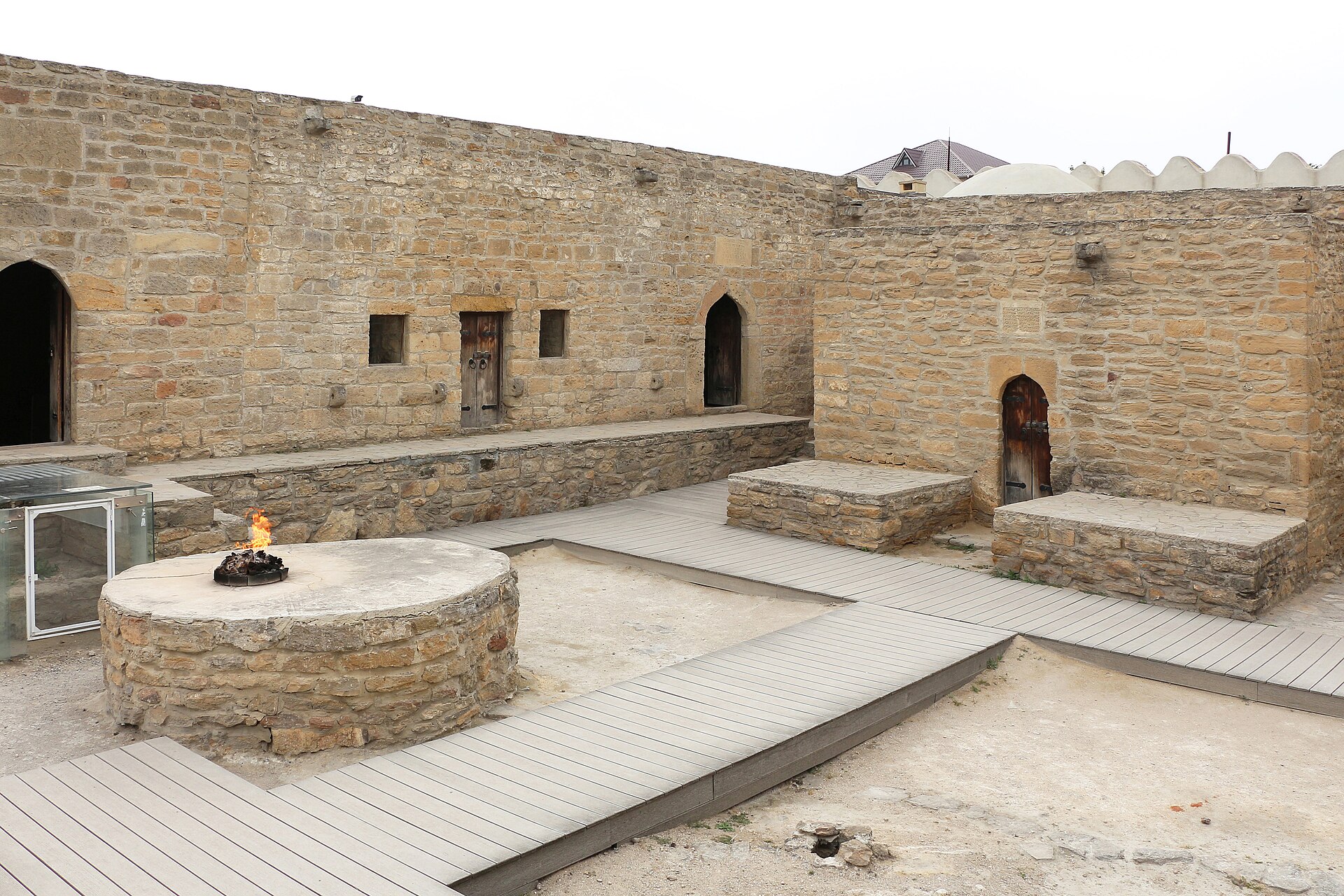
Ateshgah, the walled fire temple at Surakhani, is built around a natural gas vent that once burned continuously at its centre — a phenomenon that made the site a place of pilgrimage long before the current structure went up. Traders and ascetics travelling the routes between Persia and India are understood to have prayed here, and the temple’s cells carry inscriptions in both Persian and Punjabi, evidence of a mixed Zoroastrian and Hindu presence rather than a single tradition. Exactly how far back that pilgrimage history reaches is genuinely unclear, and it’s worth treating any single date you’re given as one version among several rather than a settled chronology.
Ateshgah remains an active place of quiet reverence for some visitors even today, and as with any site carrying religious weight, local etiquette around dress, conduct and photography is worth checking with an official source or your guide before you go rather than assumed on arrival — rules of this kind exist, shift, and are best confirmed close to your travel dates.
A short drive from Ateshgah, Yanar Dag is the more theatrical of Azerbaijan’s fire sites: a hillside where natural gas seeps continuously through porous sandstone and has been alight, by most accounts, since it was first noticed decades ago. There’s no temple here, no ritual architecture — just a wall of flame running along the base of a low slope, best seen at dusk when the fire reads clearly against the darkening hill. It’s a natural process rather than a managed one, and it needs no explanation beyond what it plainly is: gas escaping from the ground and burning where it meets air.
Baku makes an easy hub for exploring the rest of the country — Gobustan’s petroglyphs and mud volcanoes are a short run south, Sheki’s caravanserai architecture and painted palace a longer day’s drive into the hills, Shamakhi’s old minarets somewhere between the two. Domestic distances here are manageable, and a private driver-guide covers them comfortably in day trips or short overnight loops.
Azerbaijan sits at the hinge of the wider Caucasus, and it’s tempting to picture a route running straight on into Georgia or Armenia by road. We’d rather not build an itinerary on an assumption like that: overland crossings in this region open, close and change status without much warning, and we don’t advertise a route across a border we can’t vouch for on any given week. What we do instead is arrange the connections properly behind the scenes — flying or routing you between countries so the journey holds together without leaning on a crossing that may not be usable for tourists at the time you travel. Our Caucasus Triangle corridor, linking Baku, Sheki and Kakheti through to Tbilisi, Kazbegi and Yerevan, is built with exactly that caution in mind.
Entry requirements for Azerbaijan, as for anywhere in the region, are worth confirming directly with the relevant embassy or an official source close to your travel dates rather than relied on from any guide, including this one — they are the kind of thing that changes without much notice. The same goes for any rules around photography, dress or conduct at religious sites like Ateshgah; check before you travel rather than assume.
As for the practical shape of a trip — departure dates, room categories, exactly what’s included on a given day — those specifics are available on enquiry rather than fixed here, since they vary by season and by how a itinerary is built around your dates. Our Land of Fire tour is the natural base for a Baku-and-fire-temples visit — the fixed itinerary runs the old city, Gobustan and Sheki, with Ateshgah and Yanar Dag added as a half-day from Baku on request, and the Azerbaijan destination page carries the wider picture of what the country offers beyond Baku, from Gobustan to Sheki’s silk-road caravanserais.
Photo: Bernard Gagnon, CC BY 4.0, via Wikimedia Commons
The Caravan Letter
No noise. One considered letter on where to go in the Orient and when, written by the people who plan these journeys.
