The Journal · 18 September 2026
Best Time to Visit Central Asia | Explore Orient
Explore Orient Editorial
The Journal · 18 September 2026
Explore Orient Editorial
Ask five guides across the region when to come and you will get five different answers, each true for a different stretch of ground. Central Asia is not one climate but several stacked against each other — desert basin, river oasis, alpine steppe, high mountain pass — and no single sourced consensus figure for an exact “best months” window exists that could honestly cover Bukhara’s summer furnace and the Tian Shan’s snow line in the same sentence. What follows is a season-by-season read of what the region actually does, month by month, so you can match the trip to the ground rather than the other way around.
Spring is when the desert cities remember they are also gardens. Through March and April, Uzbekistan’s Fergana and Zarafshan valleys break into blossom, the Registan’s sandstone catches a softer light, and the heat that will later flatten Bukhara’s afternoons has not yet arrived. Kazakhstan’s steppe turns from straw to green almost overnight, and the foothills around Almaty fill with wildflowers before the high passes fully open. Kyrgyzstan lags a little behind — its jailoo pastures are still thawing — but lowland Bishkek and the Chüy valley are already pleasant. This is a gentle season for city-and-caravanserai touring, the kind covered on The Golden Road to Samarkand, which threads Tashkent, Khiva, Bukhara and Samarkand by high-speed rail while the light is still forgiving.
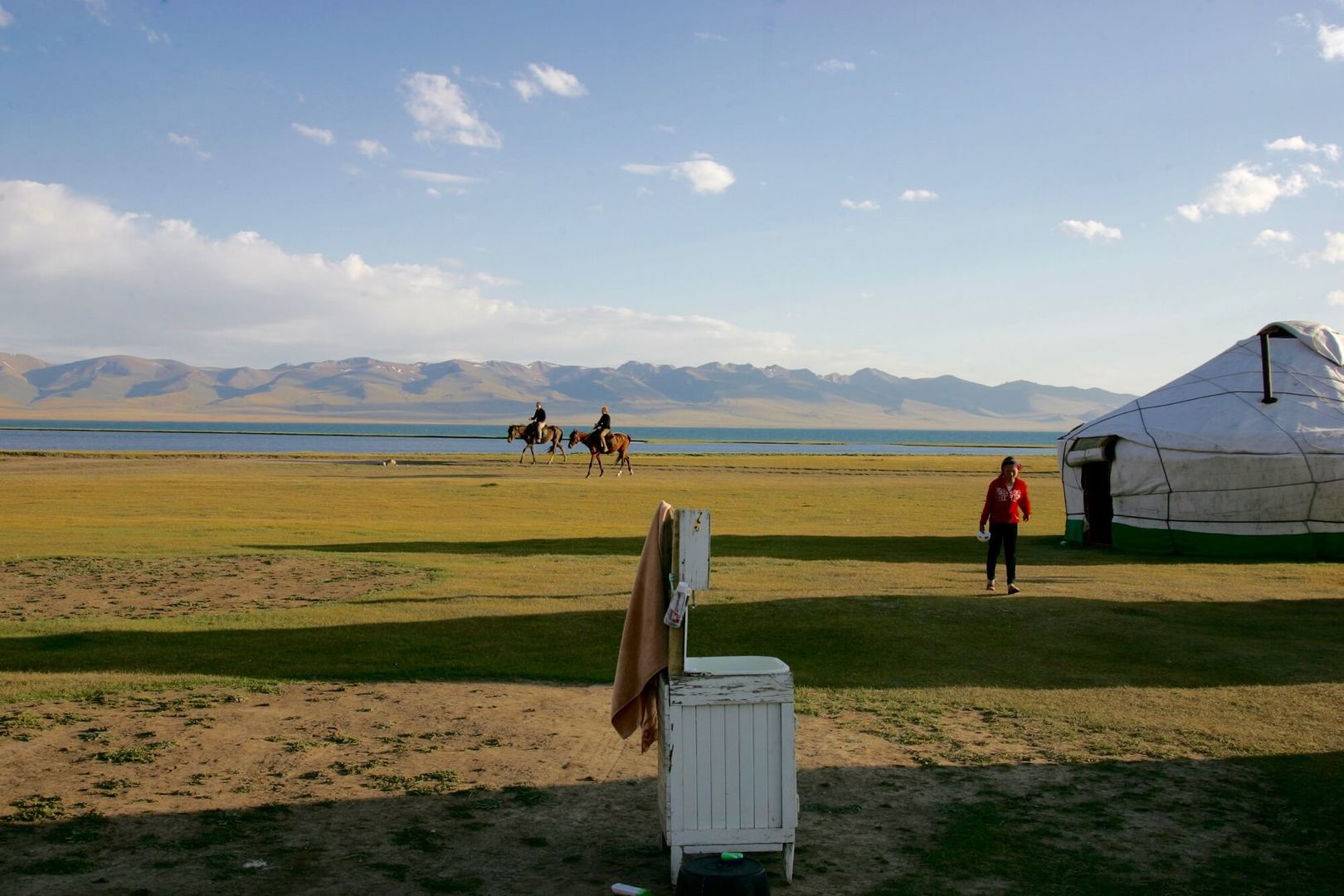
Summer splits the region cleanly in two. Down in the desert basins — Bukhara, Khiva, the Karakum around Ashgabat and Darvaza — the heat is real and unrelenting, and midday touring in July or August asks a lot of anyone. This is when the mountains earn their keep. Kyrgyzstan’s high pastures and the borderlands toward Tajikistan turn cool and green just as the lowlands cook, and it is the season the nomads themselves choose for their summer camps. Nomad Summer is built entirely around this window — yurt camps and horseback days at Song-Kul, the warm shallows of Issyk-Kul, the games still played at altitude. Further south, Lakes of the Fann in Tajikistan trades desert heat for turquoise water and day-hikes between Iskanderkul and the Seven Lakes. The rule of thumb: chase altitude in summer, and save the desert cities for the shoulder seasons either side.
If spring is blossom, autumn is harvest, and it may be the most flattering season the Silk Road cities get. From September into October the heat breaks, the bazaars fill with melons, pomegranates and the first pressings of the grape harvest, and the light across Samarkand’s tilework turns the particular gold that photographs never quite capture. Kazakhstan’s Charyn Canyon and the Tian Shan foothills around Almaty take on their own autumn colour, well suited to the shorter loop of Almaty & the Celestial Mountains. Further afield, the whole sweep of The Five Stans — steppe to desert to mountain lake — runs comfortably in this window, and it is generally the season Central Asia’s own tourism calendars point toward for the classic Silk Road cities, though we would rather send you to a specific board’s published data than assert a single verified date range ourselves.
Winter narrows the map rather than closing it. Snow settles hard across the Tian Shan and Pamir, and the high passes that carry road traffic between Kyrgyzstan’s valleys or into the Fann Mountains become far less predictable — this is not the season for ambitious overland mountain routes, and any itinerary through that terrain should be planned around what is actually passable at the time of travel rather than assumed. The desert cities, by contrast, come into their own: Bukhara and Khiva in December are cold but clear, empty of the summer crowds, and the marble boulevards of Ashgabat take on a stark, almost lunar quality that suits The Door to Hell Expedition’s night at the Darvaza crater rather well — the burning gas glows brighter against a colder, darker sky. Winter, in short, is a season for the lowland Silk Road and a poor one for the high steppe and mountain passes.
Because Central Asia’s climates run in bands rather than a single seasonal switch, the honest answer to “when should I go” is usually “it depends which half of the region you mean, and in what order.” A route built around Uzbekistan’s cities reads very differently in April than the same weeks spent in the high pastures of Kyrgyzstan or the glacier valleys of Tajikistan, and a full traverse such as The Silk Road — Istanbul to Samarkand and on toward Almaty — has to be sequenced with the seasons in mind rather than booked as a fixed calendar block. Specific departure dates and itinerary inclusions for any of these journeys are available on enquiry rather than fixed in advance, since a well-built route across five countries and three climate zones is assembled around your own dates as much as the season’s. Talk to us about what you want to see, and we will tell you which months put the light, the temperature and the passes on your side.
Both sit slightly outside the usual spring/autumn rhythm of the Uzbek Silk Road cities. Kazakhstan’s steppe and canyon country rewards the shoulder seasons much as its neighbours do, but its scale means weather can vary sharply between Almaty’s foothills and the open steppe on the same week. Turkmenistan, largely desert, follows the lowland pattern closely — brutal in high summer, striking in the cooler months either side, which is when most travellers time a visit to Ashgabat, Merv and Darvaza.
Photo: Kalpak Travel, CC BY 2.0, via Wikimedia Commons
The Caravan Letter
No noise. One considered letter on where to go in the Orient and when, written by the people who plan these journeys.
