The Journal · 26 September 2026
Darvaza Gas Crater: A Traveller's Guide to Turkmenistan's 'Door to Hell'
Explore Orient Editorial
The Journal · 26 September 2026
Explore Orient Editorial
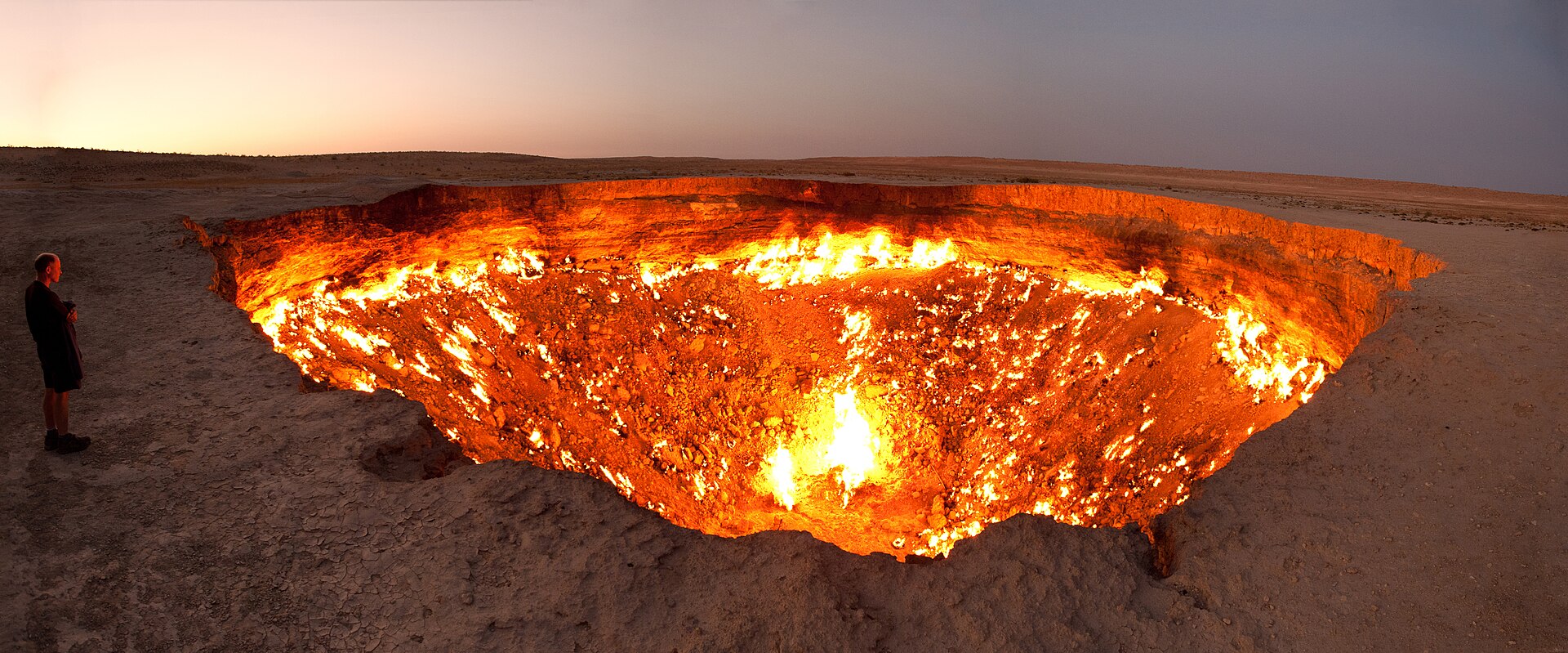
Out in the Karakum — the desert that occupies most of Turkmenistan, its name meaning simply “black sands” — the earth has been quietly burning for decades. The Darvaza crater sits in a natural gas field, and its flames are fed by seepage from that same field igniting at the surface. Exactly how the fire first started is the subject of more folklore than fact, and rather than repeat a story no one can source, it’s enough to say what’s certain: gas escapes, it burns, and it has kept burning for as long as most travellers now living can remember. That is not a promise of permanence: Turkmenistan has more than once announced an intention to extinguish it, and no guide — this one included — can tell you what state the crater will be in on the day you arrive. We confirm it before any departure is committed. The crater itself is commonly cited at approximately 70 metres across, a figure widely used by travel references such as Atlas Obscura rather than any measurement we can put our own name to — but it gives a fair sense of scale before you stand at the rim yourself.
By day the crater is a wide, smoking scar in flat desert, unremarkable at a glance. By night it becomes something else entirely — a slow amphitheatre of orange flame set against a sky with almost no competing light, which is really the whole reason to make the journey.
Darvaza lies roughly midway across the Karakum on the road north from Ashgabat toward Dashoguz, and the drive out from the capital typically runs a matter of hours through flat, increasingly empty desert — the kind of drive that does the job of easing you out of marble Ashgabat and into the Turkmenistan that most visitors actually came for. Exact routing, timings and vehicle arrangements depend on the wider itinerary, and specifics are available on enquiry rather than fixed in advance here.
The desert punishes extremes at both ends of the year — summer heat that makes daytime crater visits fairly grim, and winter nights that turn seriously cold once the sun drops. Spring and autumn tend to offer the more forgiving middle ground, with warm days and manageable nights for the camp beside the crater. Whatever the season, once you’re camped nearby, be ready for the desert’s characteristic swing: warm dusk, sharp overnight chill, and a stillness broken only by the crater’s low roar. Tents pitched a respectful distance from the rim, a fire of a different, gentler kind for dinner, and a night sky largely free of ambient light — that combination is the actual reward of coming this far, more than the crater itself.
Entry requirements for Turkmenistan change and are qualified by nationality, so they’re never something to take as read from an article — confirm the current position directly before committing to dates. What’s fixed is the shape of how the country is visited: this is not a place for improvised solo travel, and access runs through escorted itineraries with a Letter of Invitation arranged in advance. Handling that paperwork — the LOI, protocol and accreditation — is exactly the kind of groundwork our Turkmenistan partner desk manages end to end, so the traveller’s job is simply to turn up with the visa in hand.
Darvaza rarely sits alone on an itinerary — it’s usually the centrepiece night sandwiched between marble Ashgabat and the ancient ruins of Merv, and that’s precisely the shape of The Door to Hell Expedition, our five-day private, escorted route through Ashgabat, Darvaza, Mary and Merv. For travellers wanting to fold Turkmenistan into a longer Central Asian arc, the crater and Ashgabat also appear as the western anchor of The Five Stans, our sweep across all five republics from Almaty to the burning crater itself, and of The Silk Road corridor tracing the old caravan route from Istanbul to Samarkand. Specific departure dates and inclusions for any of these are available on enquiry — get in touch and we’ll build the timing around you.
Photo: Tormod Sandtorv (original picture) Hellbus (derived work), CC BY-SA 2.0, via Wikimedia Commons
The Caravan Letter
No noise. One considered letter on where to go in the Orient and when, written by the people who plan these journeys.
