The Journal · 26 September 2026
The Kasbah Route: A Travel Guide to Southern Morocco
Explore Orient Editorial
The Journal · 26 September 2026
Explore Orient Editorial
There is a stretch of southern Morocco where the land itself turns to architecture — where riverbanks buckle into fortified villages the colour of the earth beneath them, and every valley seems to hold one more citadel catching the late sun. This is the kasbah route, and it remains one of the great overland journeys of the Maghreb.
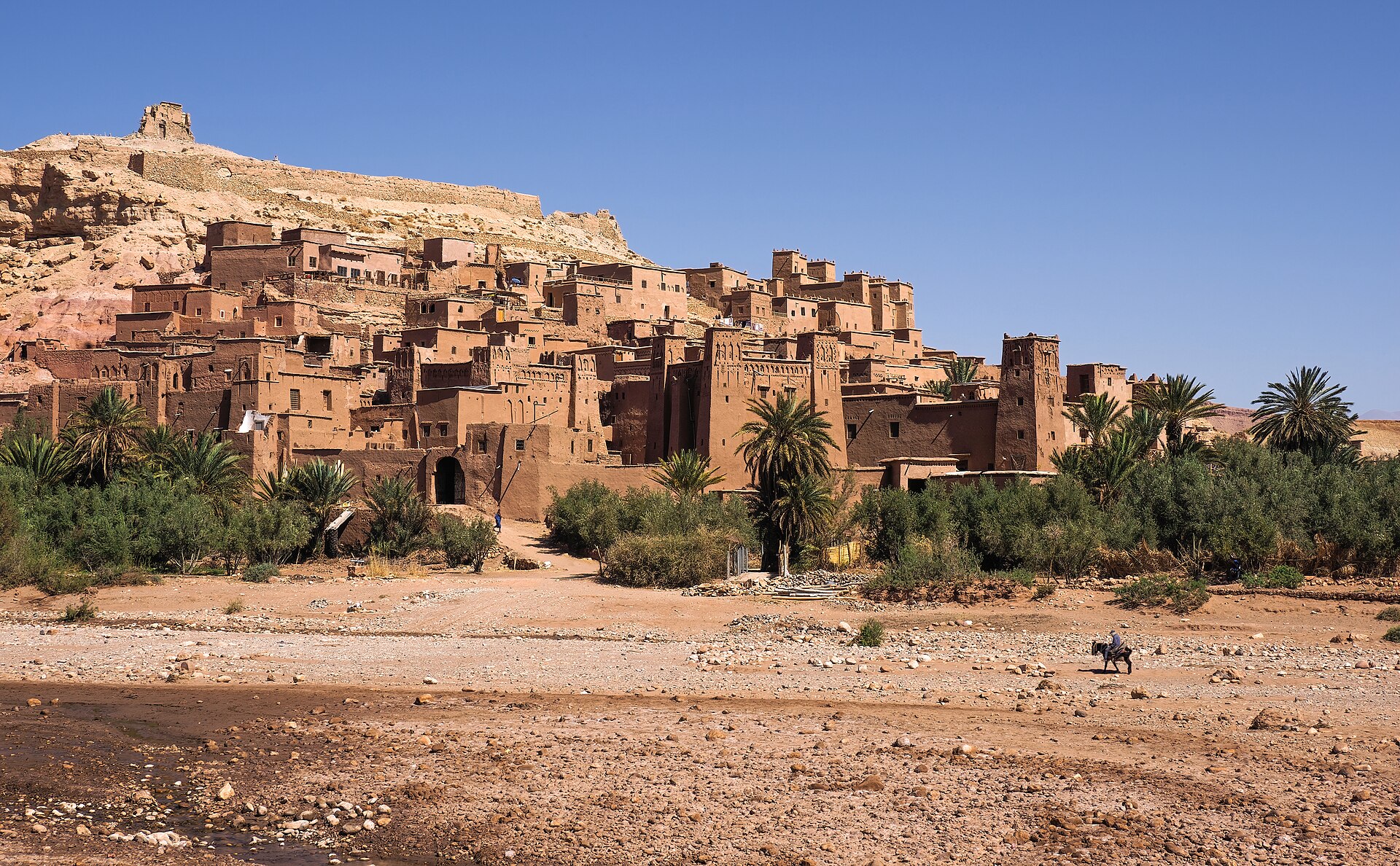
Aït Benhaddou, the route’s most photographed ksar, was inscribed on the UNESCO World Heritage list in 1987 — a recognition, per UNESCO’s own listing, of the fortified village’s earthen architecture and its role as a staging post on the old caravan roads between the Sahara and Marrakech. Its towers of pisé, rebuilt and re-rendered by generations of the same families, still rise above the Ounila river much as they would have when caravans crossed here laden with salt and gold.
The route threads together a handful of places, each with a distinct character. Aït Benhaddou is the set-piece: a cluster of ochre towers and crenellated walls climbing a hillside above a seasonal river, its narrow lanes still home to a handful of families despite the tour buses. A short drive on, Ouarzazate trades fairy-tale silhouette for a working desert town — the gateway city where caravan routes once converged and where, more recently, film studios have made use of the same clear desert light that drew traders centuries earlier. Its own kasbah, Taourirt, gives a sense of the scale a wealthy caïd’s household could reach.
Further east, the road climbs and narrows into the Dades and Todra gorges, where rose-coloured cliffs pinch to barely a car’s width in places and Berber villages cling to terraced valley floors. Kasbahs here are smaller and less restored than Aït Benhaddou’s showpiece, but no less striking against the gorge walls — and they are where the route’s earthen architecture feels most lived-in rather than staged.
Geographically, the kasbah route runs west to east along the southern flank of the High Atlas, tracing the old trans-Saharan trade corridor from Marrakech towards Merzouga’s dunes. It is not a single road so much as a sequence of passes and river valleys, best absorbed over several days rather than rushed in one long transfer — the light on the kasbahs changes markedly from morning to late afternoon, and the gorges reward a slow pass-through rather than a drive-by. Exactly how those days are sequenced, and where the overnight stops fall, is something we set at the itinerary stage rather than fix in advance; a private guide and driver shape the pacing around your interests, whether that means lingering an extra hour in Aït Benhaddou’s lanes or pushing on to catch Merzouga’s dunes before dusk.
Our own Kasbahs & Caravans tour follows this exact corridor over eight days, from Marrakech’s medina through Aït Benhaddou, Ouarzazate and the Todra Gorge to a night among Merzouga’s dunes before finishing in Fes.
Southern Morocco’s climate swings hard between seasons. Spring and autumn bring mild days and cool evenings across the kasbah route, comfortable for the walking and driving the itinerary demands. Summer is a different proposition entirely — the Dades and Todra valleys hold heat, and the approach to the Sahara near Merzouga turns punishing by midday. Travellers set on a summer visit are better served by an early start and a long, shaded pause through the hottest hours, much as the route’s original caravans would have done.
Marrakech makes the natural start and end point for a kasbah route journey, with the medina’s riads offering a soft landing before and after the desert stretches. Ouarzazate functions as the route’s working hub — most itineraries overnight there or nearby before pressing on to the gorges — while a night camped at the edge of the dunes near Merzouga is, for most travellers, the emotional high point of the whole route: the kasbahs give way entirely to open sand and a sky with nothing to compete with it.
Morocco currently sits among the more straightforward MENA destinations to plan around from an entry standpoint, though rules of this kind shift without warning — always confirm current entry requirements directly with the relevant embassy or consulate before booking. Specific departure dates, room categories and inclusions for a kasbah route itinerary are available on enquiry rather than fixed in a guide like this one, since they’re set around your season, your pace and your starting city. Our Morocco destination page has further background on the country as a whole, and the Kasbahs & Caravans tour remains the fullest expression of this route as we run it — eight days, private throughout, from Marrakech’s medina to Fes by way of every kasbah worth stopping for.
Photo: Petar Milošević, CC BY-SA 4.0, via Wikimedia Commons
The Caravan Letter
No noise. One considered letter on where to go in the Orient and when, written by the people who plan these journeys.
