The Journal · 18 September 2026
Uzbekistan Cultural Tour Guide: Samarkand, Bukhara and Khiva
Explore Orient Editorial
The Journal · 18 September 2026
Explore Orient Editorial
There is a particular hush that falls over a caravan city at dusk, when the tour groups have gone back to their hotels and the tile-work catches the last low light. Uzbekistan holds three of those cities in close enough range that a single well-planned journey can move between them by rail in an afternoon — Samarkand, Bukhara and Khiva — and a fourth, Shakhrisabz, close enough to visit from Samarkand. Together, the historic centres of Samarkand, Bukhara and Shakhrisabz, along with Itchan Kala, the walled inner city of Khiva, appear on UNESCO’s World Heritage List — a rare concentration of Silk Road architecture surviving in continuous urban fabric rather than as isolated ruins. This is a guide to what each city actually offers a traveller, and how a cultural itinerary through them tends to be built.
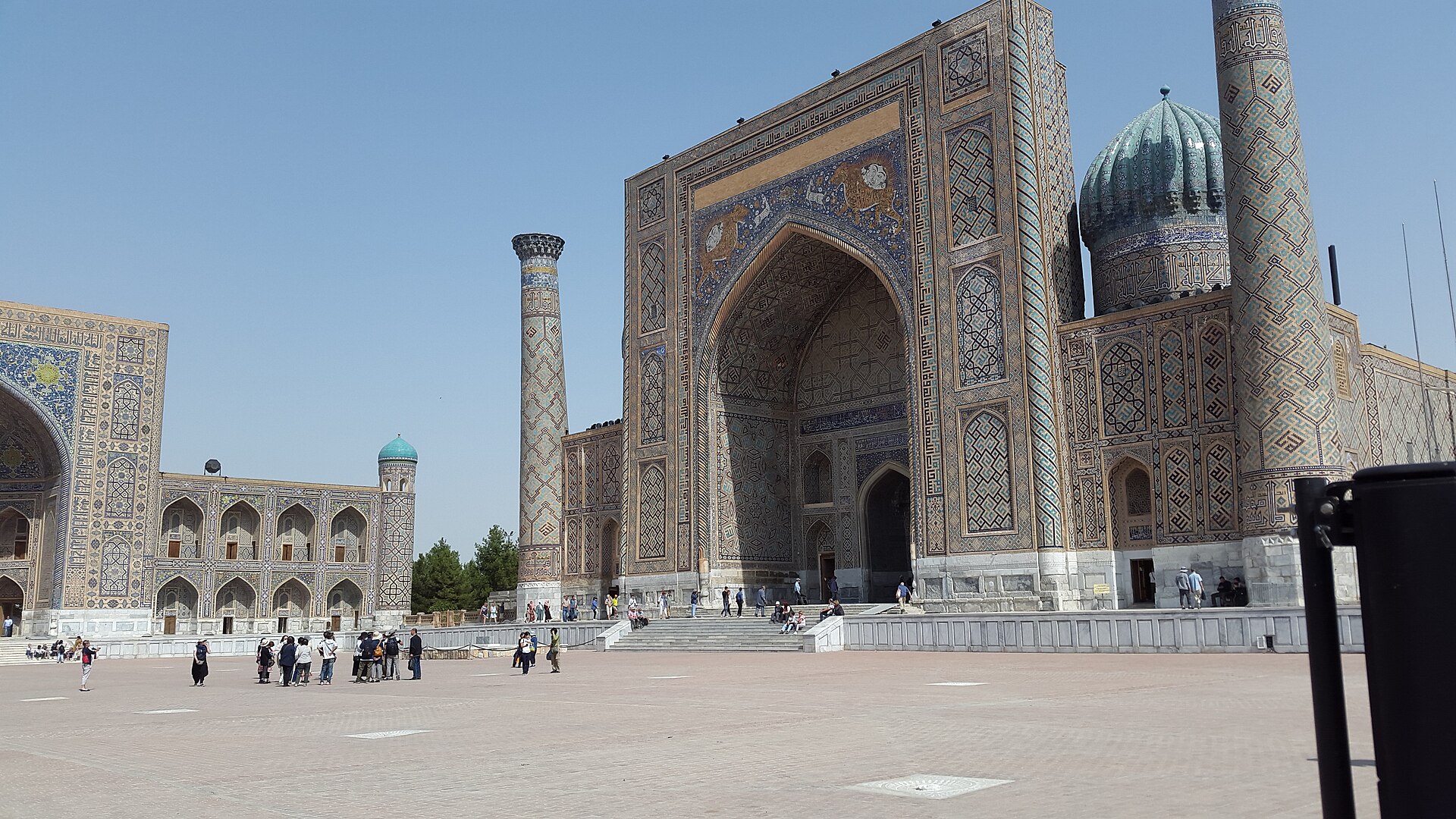
Samarkand’s fame rests, fairly, on the Registan — three madrasas facing one another across a single square, their portals and domes tiled in the blues and turquoise that give Timurid Samarkand its signature palette. The ensemble was built up over roughly two centuries, and it still functions as the city’s civic heart in a way that few historic monuments manage: locals cross the square on ordinary errands, and it lights differently at every hour, which is why serious photographers plan around both dawn and evening visits rather than the midday tour-bus window. Beyond the Registan, the city carries the weight of its Silk Road role as a crossroads city under Timur and his successors, with mausoleums, observatories and necropolises scattered through the old quarters that reward slow, guided walking rather than a rushed pass-through. Our Golden Road to Samarkand tour spends real time here, timed to the light, before continuing on to Bukhara.
Where Samarkand reads as monumental, Bukhara reads as lived-in. Its old city is smaller and denser, built around a cluster of domed trading arcades — Toki Zargaron, Toki Telpak Furushon and others — where merchants once sold jewellery, headwear and silk under the same brick vaults still standing today. The Kalyan minaret rises above the old town as it has for centuries, paired with the Kalyan Mosque and the Mir-i-Arab Madrasa across the square, and the old city’s layout rewards aimless wandering between them — courtyard mosques, caravanserai remnants and quiet residential lanes sit within a few minutes’ walk of the main monuments. It is a city best absorbed on foot, ideally with a guide who can point out which dome belonged to which trade. The Golden Road to Samarkand and the broader Five Stans corridor both give Bukhara the days it needs rather than treating it as a stopover.
Khiva is the most self-contained of the three. Its old town, Itchan Kala, sits entirely within a ring of mud-brick walls, and because so much of it survives intact — minarets, madrasas, the Khan’s palace, narrow lanes between close-set buildings — the whole inner city can feel like a single, walkable museum piece rather than a scattering of sights across a modern city. That compactness is exactly its appeal: an evening walk after the day-trippers leave, when the walls glow ochre and the lanes empty out, is one of the more atmospheric hours available anywhere on the Silk Road route. It is also, practically, the farthest of the three cities from Tashkent, which is why most cultural itineraries treat it as a dedicated leg rather than a day trip — Uzbekistan as a destination page lays out how the geography tends to work.
The logical order — Tashkent, Khiva, Bukhara, Samarkand — is the one built into the Golden Road to Samarkand, an eight-day route that uses high-speed rail to link the cities rather than long road transfers, leaving more time in each old town and less in transit. Travellers wanting to see Uzbekistan as part of a wider Central Asian arc can extend into Kazakhstan, Kyrgyzstan and Tajikistan on The Five Stans corridor, or connect westward toward Turkey and the Caucasus on The Silk Road. Specific tour inclusions, current departure dates and rates are available on enquiry — we’ll build the itinerary around the season, the pace and the level of comfort you’re after, rather than fitting you into a fixed template.
Photo: Shuhrataxmedov, CC BY-SA 3.0, via Wikimedia Commons
The Caravan Letter
No noise. One considered letter on where to go in the Orient and when, written by the people who plan these journeys.
