The Journal · 18 September 2026
Caucasus Multi-Country Itinerary: Georgia, Armenia and Azerbaijan
Explore Orient Editorial
The Journal · 18 September 2026
Explore Orient Editorial
There is a particular pleasure in a region small enough to hold in one itinerary and large enough that it never repeats itself. The Caucasus does this better than almost anywhere else on the map — three nations, three alphabets, three very different relationships with wine, faith and fire, all folded into a mountain range that never quite lets you forget it’s there. No single sourced figure exists for how long a standard Caucasus circuit should run — trip lengths vary by operator and by traveller, and we won’t invent a consensus that isn’t ours to claim. What we can tell you, from having threaded this route many times, is how the three countries fit together, and why the order you visit them in matters more than the number of days you give it.
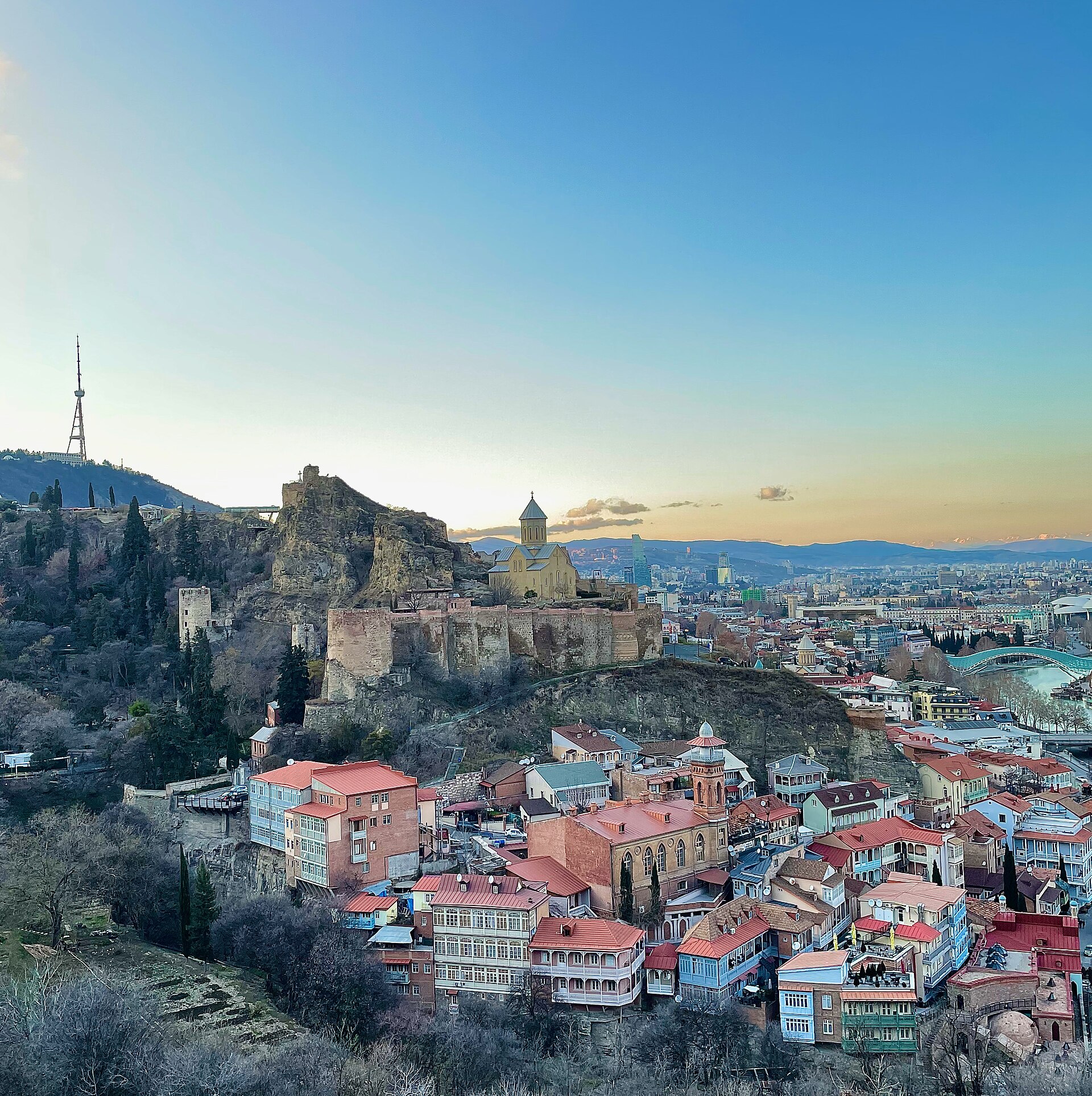
Tbilisi announces itself in layers. The old town climbs a hillside in balconies and carved wooden facades, sulphur baths steaming below the Narikala fortress, church bells competing with the call of vendors selling churchkhela in the market lanes. It is a city built for wandering rather than checklisting — you find its best moments by turning down the street you weren’t planning to take.
An hour or two east, Kakheti changes the register entirely. This is Georgia’s wine country, where qvevri — the buried clay vessels that predate almost every other winemaking tradition still in use — sit in cellars that families have kept for generations. The valley floor is a patchwork of vines under the wall of the Greater Caucasus, and a lunch here tends to run long, punctuated by toasts that are less ritual than genuine argument about whose harvest was better. Explore Orient’s Caucasus Crossing tour builds exactly this rhythm — Yerevan’s brandy cellars into Tbilisi’s balconies and on to the vineyards of Kakheti — while our dedicated Georgia page covers the country on its own terms, for travellers who want Georgia in full rather than in passing.
Cross into Armenia and the light changes — pink volcanic stone instead of Tbilisi’s timber, and Mount Ararat sitting on the horizon like something the country still hasn’t finished mourning. Yerevan itself is compact and confident, its cascade of stairs and galleries a modern counterpoint to what surrounds it.
What surrounds it is monastery country. Geghard is carved directly into a cliff face, its inner chambers cut from the rock rather than built upon it, and the acoustics inside do something to hymn-singing that no built cathedral quite manages. Khor Virap sits closer to the Ararat plain, a monastery with the mountain framed behind it so precisely that photographers have been chasing the same shot for a century. Both sit within easy reach of the capital, and both reward slow visits rather than fast ones. Explore Orient runs Monasteries & Brandy, a six-day route through Garni, Tatev and Lake Sevan that takes in this cliff-and-cellar Armenia properly, and our Armenia destination page is the place to start if this leg is the one pulling you in.
Baku is the surprise for most first-time visitors — a walled medieval core, all narrow lanes and caravanserai courtyards, set against a skyline of glass towers and the flame-lit boulevard along the Caspian shore. It is a city comfortable holding both halves of itself at once, and the old city’s UNESCO-listed core rewards an evening spent simply walking it without an agenda. Beyond the capital, the country opens into rock art at Gobustan, the mountain silk-weaving town of Sheki with its painted palace, and a countryside that still feels lightly visited compared with its neighbours. Explore Orient’s Land of Fire tour covers this arc in five days, and the Azerbaijan destination page gives the fuller picture for anyone building a trip around it alone.
The question that arrives sooner or later is simple: can you move between these three countries overland, in one continuous loop? The honest answer is that border situations in this region shift, and some crossings are not usable by travellers at any given time — we won’t claim a specific road or crossing is open, because that claim can go stale the moment it’s made, and getting it wrong costs a traveller a day they can’t get back. What we will say is that Georgia, Armenia and Azerbaijan can be combined into a single, well-paced route, and that the routing itself — flights, transfers, timing — is precisely the kind of logistics Explore Orient exists to handle. Our Caucasus Triangle corridor is built for exactly this: Baku to Sheki to Kakheti to Tbilisi to Kazbegi to Yerevan to Tatev, sequenced by people who have actually moved through it, rather than assembled from a map. If your ambitions run further east, the same logic extends into The Silk Road corridor, which threads the Caucasus into Persia and Central Asia in one longer arc.
We won’t hand you a rate or a departure date here that we haven’t actually issued — no proprietary figure for this specific route exists in what we have in front of us, and we’d rather tell you that plainly than invent one. Specific dates, inclusions and current pricing for any of the tours above — the Caucasus Crossing, Land of Fire, Monasteries & Brandy, or a bespoke build across all three countries — are available on enquiry. Visa requirements for each of the three nations also shift over time, so treat anything you read anywhere, including here, as a starting point rather than the final word, and confirm directly before you book flights. What we can promise is a route sequenced by people who have driven it, walked it, and argued over the toasts in Kakheti themselves.
Photo: LeontinaVarlamonva, CC0, via Wikimedia Commons
The Caravan Letter
No noise. One considered letter on where to go in the Orient and when, written by the people who plan these journeys.
